Antarctica by Redeye
Yesterday we didn’t sleep much. We boarded our plane to Antarctica at 10 p.m., and by 4:20 in the morning we were standing on a carpet of sea ice. The sun was warm on my face, the sky was a spotless blue, and not many people needed their Big Red parkas. The temperature rose to 36 degrees.
We spent our day moving through a succession of large vehicles: a giant C-17 jet, a very large people-mover called Ivan the Terra-Bus, and finally onto our home for the next month, the great big Nathaniel B. Palmer icebreaker. Read on through the slideshow for the full story.
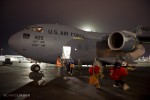
- The C-17 that took us to Antarctica is an enormous jet, capable of taking 120 people and several hundred thousand pounds of cargo the 2,000 miles to the ice in just over 5 hours. We boarded it in darkness, climbing the short ladder and walking into a brightly lit interior. In just a few hours we replayed this in reverse, climbing out of the dimly lit cabin and into a sparkling world of ice and sky.
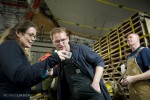
- Scientists of all types come to Antarctica. On our flight we had physicists, biologists, engineers, chemists, and geologists, as well as McMurdo staff preparing to spend the whole of the Antarctic winter down on the ice—six months with no visitors. Everyone is excited to visit such a remote part of the world. Here, graduate student Elizabeth Halliday, who is studying phytoplankton on our voyage, shows her photos to a couple of Swedish physicists bound for the South Pole’s Ice Cube project. They study subatomic particles called neutrinos using a detector that is a kilometer wide, a kilometer long, and a kilometer deep in the polar ice.
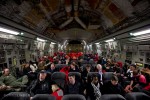
- Inside the C-17 it’s easy to forget you are in a plane. The windows are about 10 feet off the floor, meaning you can’t see outside. The walls are covered with ventilation ducts, wiring, and spare equipment; the ceiling seems almost out of sight. People sit along the walls and in the center aisle along with oversize pieces of cargo (see next image). Everyone wears earplugs to drown out the plane’s noise, and I couldn’t tell we were on the runway until the thrust from the jet engines pushed me backward.
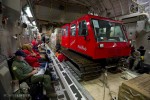
- In the previous picture, that wood ‘wall’ you see in the background is only about halfway down the plane. Behind it there’s still room for a brand-new, cherry-red Pisten Bully. It’s a caterpillar-tracked vehicle great for traversing uneven rocky ground, snow, and ice. Scientists use it to transport people and tow gear across the sea ice.
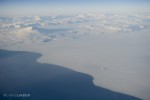
- We took off in the middle of the night, but a few hours later we were far enough south that the sun had come back up. At first we saw open ocean, and then the first peaks of Victoria Land, the mountainous terrain that forms the western edge of the Ross Sea. In a few days we’ll be back up here, near Cape Adare, to work on recovering Dr. Bruce Huber’s deep-water instruments after three years underwater.
- It’s impossible to forget the moment you climb out, eyes blinking, into the blinding white of Antarctica. We’ve landed on a runway made of sea ice—the only flat surface around. Great mountain ranges sit on the horizon, reminding us that we are on the edge of a vast, uninhabited, unspoiled wilderness. This ice merges with the Ross Ice Shelf and stretches 800 miles southward in an unbroken sheet. The dry, clear air plays tricks with your eyes and makes distant objects clearly visible.
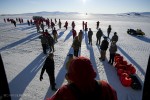
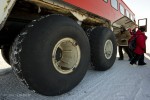
- After everyone has a chance to snap a few photos and take in their first view of the Great White Continent, we board an immense transport lovingly called Ivan the Terra-Bus. It takes us back 10 miles across the ice to Hut Point and McMurdo Station. At one point the driver calls out as he notices a couple of emperor penguins that have wandered into view in the distance.
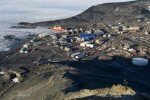
- Observation Hill is the highest promontory above McMurdo Station. We’re at the southern end of the Ross Sea here—when the ice breaks out, this will be the southernmost open water in the world. This area has been home to Antarctic explorers since 1901—the expedition’s hut is still standing in the distance, next to our orange-hulled ship. These days, more than 1,000 people live here during the summer (about 200 spend the winter). Right now it’s a bustling town, with water melting in the warm sun and heavy trucks shuttling equipment along the gravel roads. Many of them are headed down to the ice pier, loaded with equipment for our voyage.
- Our ship, the Nathaniel B. Palmer, is docked and waiting for us at the ice pier. The ship, built in 1992, is 308 feet long, with a displacement of 6900 tons. Things have come a long way since Capt. Ross’s 1841 journey to the Ross Sea. His two ships had no engines at all—they were 100-foot, 340-ton sailboats made of wood reinforced with copper. The Palmer is an icebreaker capable of plowing through three feet of ice at a speed of 3 knots (1 knot = 1 nautical mile per hour, or about 1.1 mph). In the distance you can see the Royal Society mountain range, marking the southern end of Victoria Land.
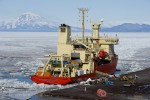
- Tonight is our first night sleeping on the ship. We’ll finish setting up scientific equipment tomorrow, and we’ll leave the dock in the early evening.


January 18, 2011 


Thanx for the awesome pix! We’re wondering if with all the noise and earplugs, could you talk on the plane?
Why does Ivan need such gigantic tires? And when you say your ship can bust through three feet of ice — is that vertical feet?
Hi and thanks for the great questions! It’s very difficult to talk on the plane once our earplugs are in and the engines are howling. It’s more like a game of charades where you gesticulate at each other but never quite know what they’re saying.
Ivan has such big tires because the sea ice and ground around McMurdo isn’t always as clean and flat as it is now – Ivan has to get over humps and ridges in the ice, move through deep or chunky snow, and negotiate the transition from ice to land.
The icebreaker is rated to break through ice that’s three feet thick at a continuous speed of three knots – that means without stopping! When the ice gets thicker, she can still break the ice by moving more slowly. When we get into thick ice later in the voyage, we’ll show you how.
What a privilege to be on this mission!
I will present your updates to the students
involved in my Marine Science/Art class. The vehicles on your site will grap their attention for still life creativity! Reflections of warmth go out to you all.:)
Thanks DRyder – it’s great to hear that you are teaching a class that combines science and art. We’d love to see some of your projects someday!
Hi Hugh!
We love reading your blog and looking at Chris’s great pictures! We have two questions:
1. How thick is the ice?
2. Have you seen any wildlife yet?
Stay warm and Bon voyage!
Hi Ms. Barnett and your students! About the ice thickness – when we left McMurdo it was still pretty thick. Some of the ice floes that had rolled over on their sides were five feet thick. But now we’re out in open water and there’s no ice at all, except for the occasional iceberg in the distance. As for wildlife, we’ve seen plenty so far – by now you may have read our post from Jan. 19, when we saw orcas, minke whales, Weddell seals, South Polar skuas, Adélie penguins, and emperor penguins. This morning we added two more species—beautiful white snow petrels (a kind of seabird) skimming over the waves, and a streamlined seal that we believe was a crabeater seal.
I was reading your blog for HW because our class has to answer questions. As I was reading I read that you are going to live on the Nathaniel B. Palmer icebreaker. I was wondering what you where going to live in? I thought about living in tents but for a whole month on on a ice breaker. Thats seems like it would be hard and very uncomfertable. If you do live in tents, does it get uncomfortable? Do you have to sleep in your cloths to stay warm?
Please write back,
Suzy from Ms.Barnetts 6th grade class
Hi Suzy, thanks for your question. The Nathaniel B. Palmer is a big ship about 300 feet long. It has lots of room for us inside. We get to sleep in bunks, two to a room, and most of the scientists’ work is done in laboratories on the ship. It’s pretty warm inside (in the 60s), so we don’t have to sleep in our clothes. You can see photos of what the Palmer looks like on the posts from Jan 18th and Jan 20th.
This expedition is awsome my class is learning about this. We are very interested in it. We go on the blog everyday and learn. We are following your expedition and we are inspired. We enjoy this so much. Thank you for giving us something interesting and fun to learn about. Sincerly….ME
Hi Jessica, thanks for writing. I’m glad you are enjoying these posts. If you have any questions about what we’re doing, or if you want anything explained in more detail, just let us know. We have about 25 more days to go and we’ll do our best to cover what you want.
Well Suzy when on an Ice breaker you sleep inside of it
I really love this whole expedition. It is really fun following it. I have a question. Why was this mission formed and how long did it take to get the funds and prepare for the trip?
Dear Alex, I asked our chief scientist, Dr. Josh Kohut, this question and this is what he said: “We knew from previous research that Modified Circumpolar Deep Water was an important physical feature in the Ross Sea, and our interest now is to see what impact that has on the biology and the chemistry here. So we assembled a team that could address all these different aspects. We wrote the proposal in the spring of 2008, we found out that we were awarded the proposal in 2009, and we’ve been planning pretty steadily ever since then. We still are planning!”
Hi Hugh. It sounds like you guys had a long trip! It’s really cool that you get to live in Antarctica for some time. I hope you are staying warm and safe. It is interesting that you get to record everything that goes on. I have a question: You said the sky was a spotless blue and the sun was shining at 4:20 in the morning, is it true that the sun can come out at 4:20 am?
Dear Sammy. Yes, it’s weird but in Antarctica in the summertime the sun never goes all the way down. Basically, when the sun goes around the other side of the earth and it gets dark where you are, we’re so far south that we can still see around to the other side. It’s light 24 hours a day and the sun won’t go beneath the horizon until late February. In the middle of Antarctica’s winter (summer in America), the sun never comes up and it’s dark all the time.
Hi huge sounds like fun down in Antarctica. I have a question…..How do you guys travel when you are not on the ice breaker? By snowmobile?
Dear Mike, we’re going to be on the icebreaker and away from land for 28 days total. The only ways to travel off the icebreaker are by a small boat called a zodiac (see Jan 21st post), which we use for glider launches, or if we find some thick sea ice and decide to send some scientists out to sample it. If we do that, we’ll just go down a big ramp and walk around on the ice—no snowmobiles.