Where Biology and Chemistry Meet
After three days of overcast skies and whitecaps, today the wind settled and the sky cleared. Sun warmed the observation deck on the bow, and stiff-winged snow petrels flittered among the waves as if impatient for the wind to return. We had steamed south about 120 miles to get some more information from an interesting area we had visited last week.
The ship coasted to a stop around 2 p.m. and the CTD rosette went over the side. Teams began sampling water for another round of experiments. One of these groups was the team led by Dr. Adam Kustka of Rutgers University. They are testing how phytoplankton respond when they are given Modified Circumpolar Deep Water or extra iron. Read on through the slideshow to meet the team:
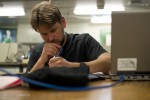
- Dr. Kustka’s team consists of five people, and he is constantly working to ensure the experiments go smoothly. This entails troubleshooting equipment, filtering water, dashing out to the trace-metal van and the ‘bubble,’ and organizing samples in a cold room called Little Antarctica. From morning until late at night he’s on the move, windproof overalls pulled up over his t-shirt, jotting notes and calculating amounts for his next experiment on his notepad.
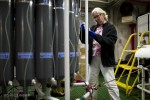
- Lora McGuinness, a lab manager at Rutgers University, prepares a water sample from the bottles brought up on a CTD rosette. Lora has been doing molecular analysis for 20 years. She learns which species of phytoplankton are living in Dr. Kustka’s samples by isolating and analyzing DNA in the water sample. Lora said she prefers research voyages in the tropics—one of her favorites went from Puerto Rico to Trinidad. ‘But everybody in oceanography would love a chance to go to Antarctica once,’ she said. So she came.
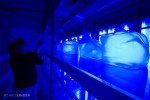
- Research technician and graduate student Ashley New places water samples in the Blue Room to incubate. The phytoplankton must be kept at the temperature they’re used to in the ocean. So even though ‘incubate’ usually means keeping things warm, this room is freezing cold. A wall of 48 blue lights make sure that all the phytoplankton have the same amount of light to grow in. This keeps cloudy or sunny weather from interfering with the experiments. Over the next 9 days, the researchers will measure the phytoplankton’s growth and see whether the iron, MCDW, or other factors they added have had an effect.
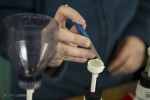
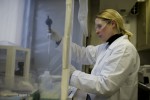
- Ashley prepares a sample of phytoplankton from an earlier incubation. She filters 200 milliliters (about 3/4 of a cup) of her sample through a glass-fiber filter to trap the living cells. The filter paper looks greenish because the cells contain chlorophyll, which Ashley will measure next. She said she doesn’t mind all the filtering that her research requires. ‘I enjoy biology, and I enjoy chemistry,’ she said, laughing. ‘And I like it best where they meet and get very confusing.’
- On an upstairs deck at the stern of the Palmer, Dr. Cecile Mioni of the University of California, Santa Cruz is inside the Rad Van. Here she adds mildly radioactive carbon and iron to water samples. The materials don’t hurt the phytoplankton, but the radioactivity makes it easy to track how these elements get used by the various phytoplankton species. Dr. Mioni grew up near Bordeaux, France. She can’t wait for the Rugby World Cup this year, when the French national team may get a chance to beat the New Zealand All-Blacks.
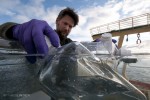
- Dr. Kustka puts a water sample into a clear-plastic incubation tank on the deck of the Palmer. Unlike the samples in the Blue Room, these will stay on deck and grow under natural sunlight. The big tank has seawater continuously pumped into it to keep the phytoplankton at the right temperature—which is very close to freezing. I think that’s why Dr. Kustka is grimacing as his hands go into the water.
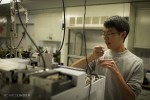
- If you’ve ever been to the beach and smelled the ocean’s seaweedy smell, you know a little about what Menglei Chu studies. That smell comes from dimethyl sulfide, a gas that can affect the planet’s climate. Menglei is trying to discover how nutrient supplies affect how much of the gas is made by an abundant kind of phytoplankton called Phaeocystis. Menglei is in his first year as a graduate student at Rutgers. He is from Zheijiang province, China. It was in middle school that his interest in biology began, he said. He liked getting to look through a microscope at tiny cells, and has been studying them ever since.
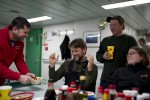
- At midnight we found out it was Dr. Kustka’s birthday. We were all in the galley (kitchen), eating a meal called ‘midrats,’ or midnight rations, which are cooked for people who have to stay up late. It wasn’t just any birthday—it was his 40th birthday. We didn’t have any candles on hand, so chief scientist Dr. Josh Kohut stuck two slices of bacon into a donut and we all sang ‘Happy Birthday’ at the tops of our voices.
In the evening the ship set course for a long steam back to McMurdo Station, where we will refuel. (We still have plenty of fuel, but the Palmer has a long voyage back to South America after our trip ends, and this is its best chance to refuel.) Getting to McMurdo will take all day tomorrow, but after we refuel we’ll head back out for another two and a half weeks of research.
From up on the bow, delicate mare’s tail clouds curled across the blue sky, and the low midnight sun lit the southern horizon. We passed a group of about 30 orcas that were spread out on either side of the ship. Their spouts were visible all around, and their long dorsal fins stood high over the waves as they broke the surface. Tomorrow, we’ll see Mount Erebus and Ross Island on the horizon again.


January 27, 2011 


I was wondering because you have been there before can you tell the difference in the ice from Global Warming.
Dear Kelli. Good question, but the answer is no. When I was here three years ago it was earlier in the year, so there was more snow around. Summer was just getting going and melting was just beginning. But climate change is a long-term process that includes a lot of variability, so it would take more than two visits to be sure of change. For instance, summer is the hot time of year, but there are days when it’s cool and rainy. That doesn’t mean it’s not summer anymore. So to study climate change we need to look at a long period of time and a large area of the planet.
Happy Birthday, Adam!!!
Speaking of biology and chemistry, how’s the coffee supply holding up? I think I’ve heard that Hugh is quite the connoisseur, so I’m curious as to what you find yourself drinking to give you that pep in your step.
Also, have there been any memorable meals (besides the bacon-donut manifesto)? I would imagine that staying warm while standing on deck would keep a person pretty hungry…
Thanks!
Hi canagica. We have three coffee sources on the ship. This is a Louisiana-based ship, so the galley puts New Orleans Community Coffee in the big urns. I usually spike that with a little Nescafe instant that the ship picked up in Puntarenas, Chile, on its last port call. For the days when I need a little extra writing inspiration, I have a precious supply of shade-grown Guatemalan french roast from Tunnel City Coffee in western Massachusetts.
Meals are really good here. We’re amazed at how long avocados and kiwi fruit can keep on a ship. Also, the cooks make some delicious soups; sometimes we get fresh steaming bagels at midnight (‘midrats’) and the occasional deep dish pizza night with a thick slice of salami instead of pepperoni. There’s also plenty of Tabasco and Tony Chachere’s seasoning on every table. And warm cookies most evenings.
Happy Birthday Uncle Adam!!! Cant wait for you to come back and tell us all about what you did!
Sometimes the food isn’t good on board.Is the food good and what is your favorite meal?
Dear Dylan, the food here is great. We got a good supply of fresh vegetables before we left McMurdo, and there’s still some of those left. I like the soups, the canned peaches, the pickled jalapeno peppers, the fresh salsa when it’s available, the bean stew, the pork chops, the pizza, and the tacos. And of course, all the desserts (except banana bread).
How many other teams and people are on the boat? Have you gotten the chance to talk to the other groups about research?
Dear Jack, We’re a pretty tight-knit science team, so everyone has a chance to talk to each other about how their research is going. On this blog, I think we’ve mentioned every science project at least once by now. In all, there are 37 officers and crew and 26 scientists (plus one photographer and one writer) on the ship.
Following up on Canagica’s train of thought, I’d like to know more about the status of the three large chocolate bars you mentioned several posts back. I remember thinking at the time it didn’t sound like nearly enough to get you through the long voyage!
Dear Sophie, You didn’t see how large the chocolate bars were! Actually, I am rationing them, but it’s made easier by the several desserts that are available at every meal.
What is the thickest ice that you had to drive though and could you hear the ice craking.
Hi Dylan, We’ve had to break through ice floes a couple of feet thick. We definitely hear the ice cracking. Depending on what part of the ship we’re in, it can be deafening. From up on the bow it’s a loud swooshing and scraping sound as the pieces of ice drag along the hull. On the way in through the ice channel to McMurdo the ice is four feet thick or more. We wouldn’t be able to get in there on our own in such thick ice, but luckily a Swedish icebreaker called the Oden is here. Its main job is to clear out a channel for other ships to get through. So all we have to do is push our way through big broken chunks of ice.
Was there any big difference in the plankton in the natural sunlight and the plankton that s in the blue room, if so what?
Adam says: That’s a good question. The main reason we use the blue room is to provide a constant amount of light rather than the highly variable light the plankton see in the ocean. Since some plankton do not deal with variable light as well as others, the blue room may stimulate those plankton. The main reason we use the blue room is so that we can compare the results of incubations done during different times. Otherwise, our results could be complicated by very bright days followed by cloudy dark days.
How long does the planning take?
Dr. Josh Kohut says: “We started planning the proposal for this cruise in February of 2008, so about 3 years. But this is just the start of it. We’ll be analyzing the data for another 3 years after we get back. It’s a 6-year project.”
How cold is it there even though it’s the summer there isn’t it cold?
Hi Hallie, it’s pretty cold for it to be summertime, but not as cold as it has been in New Jersey. But summer is short in Antarctica, and as February goes along we’re already seeing signs of wintry weather. We’ve been in and out of snowstorms all day today.
I think this expedition is going great from my point of view. since you are actually there, do you think everybody is on schedule or ahead of schedule?
Hi Nick, everything seems to be going pretty well, thanks. One advantage of this type of voyage is that the scientists are doing ‘adaptive sampling’ — they are adjusting their plan based on information they find out while we’re out at sea. This means the scientists are constantly checking in with each other and adjusting the plan to make best use of our time.
Did they find any bacteria that may be harmful to the environment in the water samples?
Hi Nick, Good question—Dr. Angelicque White and other scientists on this expedition do sometimes study harmful organisms in the water. But as far as they know, they have not found any harmful bacteria (or other organisms) in the water samples they’ve collected.