A diary of dirt. Un cuento sobre el clima.

August 20, 2010 in Ocean Gazing Podcast by Ari Daniel Shapiro

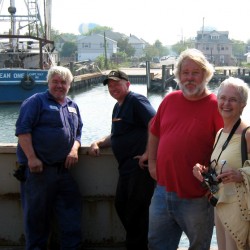
Ramon Varela (left) and Frank Muller-Karger (right) study the layers of sediment in the Cariaco Basin off the coast of Venezuela. All images courtesy of IMaRS and EDIMAR.

Frank Muller-Karger is an oceanographer at the University of South Florida where he directs the Institute for Marine Remote Sensing.

He says, “If we’re seeing something today that may have been similar to what we saw in the past, we can understand which way the planet is going to change in the future.”

Muller-Karger is using both the seafloor and satellites to figure out our past and future climate. And he’s working hand in hand with a country that’s very special to him. Have a listen.

Audio clip: Adobe Flash Player (version 9 or above) is required to play this audio clip. Download the latest version here. You also need to have JavaScript enabled in your browser.

Download the audio.

Script for Episode 41.

Send a message or a question to Frank Muller-Karger:

Photos

survival suits

Sequence of sediment trap samples from Dec 2001 to Apr 2002 (courtesy of R. Thunell, University of South Carolina).

survival suits

A hefty gravity corer that's used to sample sediment layers on the seafloor is prepped on deck.

Flasks and buoys measuring productivity.

Flasks and buoys measuring productivity.

Sediment trap recovery onboard the Hermano Gines.

Sediment trap recovery onboard the Hermano Gines.

Hear Frank Muller-Karger describe…

How satellites match up with the image I have of them that I got from the movies:

Audio clip: Adobe Flash Player (version 9 or above) is required to play this audio clip. Download the latest version here. You also need to have JavaScript enabled in your browser.

Just one example of a Venezuelan who’s translating the Cariaco Project:

Audio clip: Adobe Flash Player (version 9 or above) is required to play this audio clip. Download the latest version here. You also need to have JavaScript enabled in your browser.

Web resources

The CARIACO Project
Institute for Marine Remote Sensing (IMaRS)

The work described in this episode was funded by the National Science Foundation and the Venezuelan government.

Sounds of science

August 6, 2010 in Ocean Gazing Podcast by Ari Daniel Shapiro

Three members of the education and outreach team, Jean Marie Gautier, Brigitte Thiberge, and Stephanie Keske, regard an ocean sediment core. Credit: Bill Crawford.

We’re back aboard the JOIDES Resolution, or JR. That’s the ocean drilling research vessel in the northeast Pacific that I profiled last episode. But this time the educators and artists onboard who are doing outreach to the public have gone all over the JR, and recorded sounds and interviews. This episode is theirs, and it captures a bit of what it’s like to live aboard a massive research vessel for 2 months straight. Have a listen.

Special thanks to Lisa Crowder, one of the JR’s assistant lab officers, for lending her gift of voice and song to the end of this episode.

Audio clip: Adobe Flash Player (version 9 or above) is required to play this audio clip. Download the latest version here. You also need to have JavaScript enabled in your browser.

Download the audio.

Script for Episode 40.

Send a note to anyone you hear in this podcast, or leave them a voicemail. Do it soon, though, since the cruise ends in late August:

Photos

survival suits

Jackie Kane and Dinah Bowman practicing their skills at visual core description (including drawing). Credit: Bill Crawford.

survival suits

Science in real life. Here scientists discuss which parts of the core should receive which tests. Credit: Jackie Kane.

The JOIDES Resolution sitting tall at sea.

Outreach team member Stephanie Keske shows her mastery of the drimmel. Credit: Bejonty Richardson.

An initial image from Keske's computer visualization of the ocean drilling process.  Credit: Stephanie Keske.

An initial image from Keske's computer visualization of the ocean drilling process. Credit: Stephanie Keske.

Hear more:

High school teacher Jackie Kane recites a bit of poetry about the sounds of science onboard the JR

Audio clip: Adobe Flash Player (version 9 or above) is required to play this audio clip. Download the latest version here. You also need to have JavaScript enabled in your browser.

Chief Engineer Dan Slobodzian provides a full account of the contents of his 4 pockets

Audio clip: Adobe Flash Player (version 9 or above) is required to play this audio clip. Download the latest version here. You also need to have JavaScript enabled in your browser.

Web resources

JOIDES Resolution blog
Plugging the Seafloor with CORKs, an article from Oceanus Magazine

Scientists, teachers and artists, oh, my!

July 23, 2010 in Ocean Gazing Podcast by Ari Daniel Shapiro

Andrew Fisher (left) is on a cruise in the Pacific right now that's got a double mission: to explore the structure of the seafloor and what's alive down there, while simultaneously working with a team of educators and artists to communicate that science farther afield.

Stephanie Keske does computer visualization work, and is starting a graduate program this fall at Texas A&M University. She told me, “Just living on a ship, I think … you know, I try to be outside as much as I can so just being trapped on a floating hunk of metal is maybe going to be a little difficult. I don’t know: I’ve never been in one place with an inability to leave it for 2 months solid.”

At the moment, Keske’s in the northeast Pacific onboard an oceanographic research vessel. She and six other educators and artists from the US and France are working with the science team to do unprecedented outreach. Have a listen.

Audio clip: Adobe Flash Player (version 9 or above) is required to play this audio clip. Download the latest version here. You also need to have JavaScript enabled in your browser.

Download the audio.

Script for Episode 39.

Send a note to anyone you hear in this podcast, or leave them a voicemail. Do it soon, though, since the cruise ends in late August:

Photos

The JOIDES Resolution sitting tall at sea.

The JOIDES Resolution sitting tall at sea. Credit: The Consortium for Ocean Leadership.

These CORKs

These CORKs (Circulation Obviation Retrofit Kits) are used to plug the boreholes drilled into the seafloor.

survival suits

You just may need a survival suit one day. But until that day comes, you look silly. Stephanie Keske (L) & Jackie Kane (R).

survival suits

A smaller boat brought supplies for the CORKs to the JOIDES Resolution on some choppy seas.

Hear more:

Andrew Fisher on the practical aspects of ocean drilling research

Audio clip: Adobe Flash Player (version 9 or above) is required to play this audio clip. Download the latest version here. You also need to have JavaScript enabled in your browser.

Jackie Kane on what she plans to get out of this mission

Audio clip: Adobe Flash Player (version 9 or above) is required to play this audio clip. Download the latest version here. You also need to have JavaScript enabled in your browser.

Web resources

JOIDES Resolution blog
Plugging the Seafloor with CORKs, an article from Oceanus Magazine

Reflections

July 9, 2010 in Ocean Gazing Podcast by Ari Daniel Shapiro

The Ocean Gazing podcast is a forum for people to share their science and stories about the ocean.

I watched The Cosby Show when I was little. Sometimes they’d have an episode of flashbacks. The screen would get kind of wavy, there’d be this shimmery music, and they’d show clips from earlier episodes. Well, that’s like this episode of Ocean Gazing. It’s a look at some of the first 37 episodes to reflect on what we’re all about and where we’ve come from. Have a listen.

Audio clip: Adobe Flash Player (version 9 or above) is required to play this audio clip. Download the latest version here. You also need to have JavaScript enabled in your browser.

Download the audio.

Script for Episode 38.

What do you want to hear on Ocean Gazing in future episodes? Let me know by:

A field of green

June 25, 2010 in Ocean Gazing Podcast by Ari Daniel Shapiro

Sunset off the western shore of Oahu, Hawaii. Images courtesy of McManus lab.

Margaret McManus, an associate professor at the University of Hawaii at Manoa, says, “I definitely love my job. And the pursuit of trying to understand how the natural system works is just fascinating. It’s just what our team has a passion for.”

I caught up with her moments before she cast off the western coast of Oahu for a research cruise. These trips involve a lot of work, but it’s an incredible chance to get immersed in a swirling natural world. Have a listen.

Audio clip: Adobe Flash Player (version 9 or above) is required to play this audio clip. Download the latest version here. You also need to have JavaScript enabled in your browser.

Download the audio.

Script for Episode 37.

Tell me your favorite episode of Ocean Gazing and/or send in your questions and comments for Margaret McManus:

Photos

Margaret McManus (left) and Kelly Benoit-Bird (right) on the back deck of the Alyce C before a night cruise.

Sea Engineering's Huki Pono. This boat was used to deploy moorings for the experiment.

Ross Timmerman, Margaret McManus, Chad Waluk and Jeff Sevadjian (left to right) deploying moorings.

Recovery of the autonomous profiler in blue Hawaiian water with golden Hawaiian sunshine.

Hear Margaret McManus on:

Hawaiian stargazing

Audio clip: Adobe Flash Player (version 9 or above) is required to play this audio clip. Download the latest version here. You also need to have JavaScript enabled in your browser.

The simplicity of avocado sandwiches at sea

Audio clip: Adobe Flash Player (version 9 or above) is required to play this audio clip. Download the latest version here. You also need to have JavaScript enabled in your browser.

Web resources

Margaret McManus’ webpage
Kelly Benoit-Bird’s webpage

Music from the bottom of the food chain

June 11, 2010 in Ocean Gazing Podcast by Ari Daniel Shapiro

These creatures are the stars of this podcast episode and of the sea. Credit: www.aad.gov.au.

These creatures are the stars of this podcast episode and of the sea. Credit: www.aad.gov.au.

This time I want to play for you an episode from the podcast I host and co-produce for the Encyclopedia of Life, an online, evolving encyclopedia of every species on the planet. It’s one of my favorites.

Audio clip: Adobe Flash Player (version 9 or above) is required to play this audio clip. Download the latest version here. You also need to have JavaScript enabled in your browser.

Download the audio.

Script for Episode 36.

Send us your guess for the Sonic Stumper:

Photos

Screen shot from highermammals.com, the group who produced this special episode of the Podcast of Life.

Screen shot from highermammals.com, the group who produced this special episode of the Podcast of Life.

Dive into the world of marine biology through the Podcast of Life: The story of earth's biodiversity, one organism at a time.

Dive into the world of marine biology through the Podcast of Life: The story of earth's biodiversity, one organism at a time.

Web Resources

The Podcast of Life: The story of Earth’s biodiversity, one organism at a time
Higher Mammals

Accentuate the positive

May 28, 2010 in Ocean Gazing Podcast by Ari Daniel Shapiro

Elementary schoolers from New Jersey celebrate Rutgers Ocean Day in mid-April by cheering and waving their pompoms in the air.  Credit for all photos: Sage Lichtenwalner.

Elementary schoolers from New Jersey celebrate Rutgers Ocean Day in mid-April by cheering and waving their pompoms in the air. Credit for all photos: Sage Lichtenwalner.

Bobby Zeka, a 6th grader from Lincoln Elementary School in Kearny, New Jersey, told me: “Go all intelligent people including Albert Einstein and Isaac Newton. I love science!”

Zeka was one of 160 elementary schoolers from all over New Jersey who participated in Rutgers University Ocean Day in mid-April. It was the culmination of a year-long program where students learned about ocean science. In this episode, we’ll hear from the kids about what that was like, and what they learned.

Audio clip: Adobe Flash Player (version 9 or above) is required to play this audio clip. Download the latest version here. You also need to have JavaScript enabled in your browser.

Download the audio.

Send us your guess for the Sonic Stumper or your questions and comments about Rutgers Ocean Day:

Photos

Students from South Main Street school in Pleasantville, NJ display their poster describing the weather of Tornado Alley.

Students from South Main Street school in Pleasantville, NJ display their poster describing the weather of Tornado Alley.

Experiment showing how different types of water mix together, as demonstrated by students of Lincoln School in Kearny, NJ.

Experiment showing how different types of water mix together, as demonstrated by students of Lincoln School in Kearny, NJ.

A student regards Diamond the diamondback terrapin (a kind of turtle), the mascot of Donahue School in Barnegat, NJ.

A student regards Diamond the diamondback terrapin (a kind of turtle), the mascot of Donahue School in Barnegat, NJ.

The students from 8 New Jersey schools took time at this station to write their wishes for the ocean.

The students from 8 New Jersey schools took time at this station to write their wishes for the ocean.

Hear more about:

Joseph T. Donahue Elementary School’s reptilian mascot

Audio clip: Adobe Flash Player (version 9 or above) is required to play this audio clip. Download the latest version here. You also need to have JavaScript enabled in your browser.

The future of Ocean days according to Janice McDonnell

Audio clip: Adobe Flash Player (version 9 or above) is required to play this audio clip. Download the latest version here. You also need to have JavaScript enabled in your browser.

Web resource

Institute of Marine and Coastal Sciences at Rutgers University

One world, one ocean: Part II

May 14, 2010 in Ocean Gazing Podcast by Ari Daniel Shapiro

Eric Simms (Scripps Institute of Oceanography) discusses ocean education in the US and in China with students at Keji High School in Xiamen.  Credit: Sammy Wang.

Eric Simms (Scripps Institute of Oceanography) discusses ocean education in the US and in China with students at Keji High School in Xiamen. Credit: Sammy Wang.

Last episode, I told you about the COSEE-China Planning Workshop that was held in early March in Beijing. In this episode, we’re spending this whole time in the city of Xiamen where we flew to after the workshop. It’s in the southeast of China. They’ve got palm trees, warm, moist air. It was just beautiful. So, Xiamen? It was like Chinese Florida. We’re gonna meet high school students and college students talking about their experience with ocean education in China. And the change they want to see. Have a listen.

Audio clip: Adobe Flash Player (version 9 or above) is required to play this audio clip. Download the latest version here. You also need to have JavaScript enabled in your browser.

Download the audio.

Script for Episode 34.

Send us your guess for the Sonic Stumper or your questions about the COSEE-China trip to Xiamen:

Photos

The US COSEE delegates and the Xiamen undergrads compare notes on what everyone really should know about the ocean. Credit: Sammy Wang.

The US COSEE delegates and Xiamen undergrads compare notes on what everyone really should know about the ocean. Credit: Sammy Wang.

Vera Shi, Bob Chen, and Marilyn Decker (L to R) flip through an English text with stories about the sea at Keji High School. Credit: Sammy Wang.

Vera Shi, Bob Chen, and Marilyn Decker (L to R) flip through an English text with stories about the sea at Keji High School. Credit: Sammy Wang.

Two Xiamen U undergrads consider the Ocean Literacy brochure prepared by a few US groups, including COSEE.  Credit: Sammy Wang.

Two Xiamen U undergrads consider the Ocean Literacy brochure prepared by a few US groups, including COSEE. Credit: Sammy Wang.

Students at Keji High School listen to a couple of presentations by Bob Chen (UMass Boston) and one of their fellow students. Credit: Sammy Wang.

Students at Keji High School listen to a couple of presentations by Bob Chen (UMass Boston) and one of their fellow students. Credit: Sammy Wang.

Web resources

COSEE-China blog
Xiamen University
Ocean Literacy brochure (pdf)

Videos

1. Dinner in Xiamen: Our first meal in Xiamen was filled with seafood and culinary surprises.

2. Keji High School: The students of Keji High School and the US COSEE delegates assembled for a group photograph.

3. Xiamen karaoke I: Marilyn Decker (Boston Public Schools) and her husband John Decker sure knew how to woo their audience.

4. Xiamen karaoke II: Carrie Lee from Xiamen University was well practiced when it came to karaoke.

5. Xiamen foot massage: I tried my best to enjoy a foot massage in Xiamen. Many found it relaxing. I found it…otherwise.

One world, one ocean: Part I

April 30, 2010 in Ocean Gazing Podcast by Ari Daniel Shapiro

Xuchen Wang (left) and Bob Chen (right) from UMass Boston helped to organize the COSEE-China planning workshop in Beijing in early March.  Credit: Lundie Spence.

Xuchen Wang (left) and Bob Chen (right) from UMass Boston helped to organize the COSEE-China planning workshop in Beijing in early March. Credit: Lundie Spence.

Xuchen Wang and Bob Chen are scientists at the University of Massachusetts at Boston. Wang is from China, and he says, “Based on my experience working in China, I realized that marine science education is so limited to a few number of people. And outreach [to] the general population about marine science – it’s just not there.”

When Chen visited China with Wang several years ago, Chen was blown away: “It was clear that science was changing at a very rapid pace. They are moving on an upward trend in science and technology. And it was something that if you don’t collaborate now, you’ll be missing a lot of opportunities.”

Chen and Wang, along with numerous Chinese and American students, professors, and government officials, worked to organize the first ever COSEE-China planning workshop. The next two episodes of Ocean Gazing are devoted to this workshop and the future of ocean science education in China.

Audio clip: Adobe Flash Player (version 9 or above) is required to play this audio clip. Download the latest version here. You also need to have JavaScript enabled in your browser.

Download the audio.

Script for Episode 33.

Send us your guess for the Sonic Stumper or your questions about the COSEE-China planning workshop:

Photos

After the 2-day workshop concluded, the US and Chinese delegations visited a couple of sites in Beijing, including the Forbidden Palace.  Credit: Bob Chen.

After the 2-day workshop concluded, the US and Chinese delegations visited a couple of sites in Beijing, including the Forbidden Palace. Credit: Bob Chen.

Bargaining abounded.  At the Great Wall, Laura Dover, Ari Daniel Shapiro, and Bob Chen (left to right) purchased panda hats.  Ari got his for half what Chen paid.  Credit: Lundie Spence.

Bargaining abounded. At the Great Wall, Laura Dover, Ari Daniel Shapiro, and Bob Chen (left to right) purchased panda hats. Ari got his for half what Chen paid. Credit: Lundie Spence.

After months of planning, Bob Chen warmly welcomed the delegations from both countries to the workshop.

After months of planning, Bob Chen warmly welcomed the delegations from both countries to the workshop.

Sammy Wang and Lundie Spence became fast friends, one of the many bridges built between China and the US.

Sammy Wang and Lundie Spence became fast friends, one of the many bridges built between China and the US.

Hear more

Bob Chen shares a few of his favorite memories from our trip to China

Audio clip: Adobe Flash Player (version 9 or above) is required to play this audio clip. Download the latest version here. You also need to have JavaScript enabled in your browser.

Min Liu (Xiamen University) and Linda Duguay (University of Southern California) describe the eastern Xiamen beach

Audio clip: Adobe Flash Player (version 9 or above) is required to play this audio clip. Download the latest version here. You also need to have JavaScript enabled in your browser.

Web resources

US links
COSEE-China blog
University of Massachusetts School of Marine Sciences

Participating Chinese institutions
Nanjing University
Ocean University of China
Peking University
Tongji University
Xiamen University
Zhejiang University
National Natural Science Foundation of China
State Oceanic Administration

Videos

1. The Great Wall: On our first full day in China, we visited the Great Wall. It was blanketed in snow and thick with people.

2. Lazy Susan: A bunch of our meals were served on these Lazy Susan’s that allowed us to spin a desired dish into chopstick range.

3. Discussion groups: During one of the sessions at the workshop, we split into groups based on whether we were students, US professionals, Chinese faculty, etc and talked about what COSEE-China should look like.

4. Savory and sweet: A panoply of very different foods awaited us at the Wang Fu Jing market in Beijing. I only tried the sugar-glazed red fruits, passing on the salted scorpions and insect larvae.

5. Musical respite: On the evening following the workshop, we enjoyed a relaxing time at a local bar with live music in Beijing. Dancing ensued, though no video evidence remains.

6. Beach walk: Lundie Spence of COSEE-Southeast and Sammy Wang of Xiamen University walked along the beach, collecting treasures and snapping photographs. Their laughter splashed amongst the waves.

A Cook at sea

April 16, 2010 in Ocean Gazing Podcast by Ari Daniel Shapiro

Science teacher Mary Cook releases a weather balloon during a research cruise as part of NOAA's Teacher at Sea program.

Science teacher Mary Cook releases a weather balloon during a research cruise as part of NOAA's Teacher at Sea program.

.

Mary Cook describes Arkansas, her home state, in this way: “We have lots of rice fields. It’s also the world headquarters for duck hunting, international headquarters for Walmart, we’re number one in chicken production. I think we’re the only state in the union that has a diamond mine.”

Cook is a seventh and eighth grade science teacher at Ahlf Junior High. She says that Arkansas “used to be called the land of opportunity because of all these opportunities: the chickens, the rice, the diamonds. But I think it’s still the land of opportunity.”

Her students think so too. Listen to Mary Cook’s story, and you’ll see why.

Audio clip: Adobe Flash Player (version 9 or above) is required to play this audio clip. Download the latest version here. You also need to have JavaScript enabled in your browser.

Download the audio.

Script for Episode 32.

Send us your guess for the Sonic Stumper or your questions for Mary Cook by:

Photos

8th grader Brett Bolasco points out one of the sea creatures on display in Mary Cook's science classroom.  Credit: Mary Cook.

8th grader Brett Bolasco points out one of the sea creatures on display in Mary Cook's science classroom. Credit: Mary Cook.

8th grader Emily Rollins reads the book that her teacher Mary Cook co-authored about her time at sea.  Credit: Mary Cook.

8th grader Emily Rollins reads the book that her teacher Mary Cook co-authored about her time at sea. Credit: Mary Cook.

Mary Cook onboard the R/V Ronald H. Brown.

Mary Cook onboard the R/V Ronald H. Brown.

Bob the student-decorated drifter buoy awaits his deployment.

Bob the student-decorated drifter buoy awaits his deployment.

Web resources

Mary Cook’s Teacher at Sea book
Teacher at Sea Program
Press release about Mary Cook at sea
Ahlf Junior High School

Hear more

Mary Cook explains how she brings science to life for her students

Audio clip: Adobe Flash Player (version 9 or above) is required to play this audio clip. Download the latest version here. You also need to have JavaScript enabled in your browser.

Mary Cook describes the science taking place on the research cruise

Audio clip: Adobe Flash Player (version 9 or above) is required to play this audio clip. Download the latest version here. You also need to have JavaScript enabled in your browser.